
There’s no shortage of fear surrounding artificial intelligence. Many worry that AI will take away jobs—especially routine jobs—and make it even harder for people with intellectual and developmental disabilities (IDD) to find meaningful work.
That concern about the impact that AI will have on people with differing abilities is warranted, but it is not all the whole story.
In our experience, AI is not just replacing tasks. It’s unlocking potential. It’s helping people with differing abilities do more, communicate better, and gain more independence. And today, John and I are not only using these tools in our daily lives, we’re helping others do the same.
How AI Helps John And Why That Matters
Let’s start with my son John. John has Down syndrome. He’s also the co-founder of John’s Crazy Socks, a global keynote speaker, Special Olympics athlete, and podcast host. He’s a busy man.
John’s Research
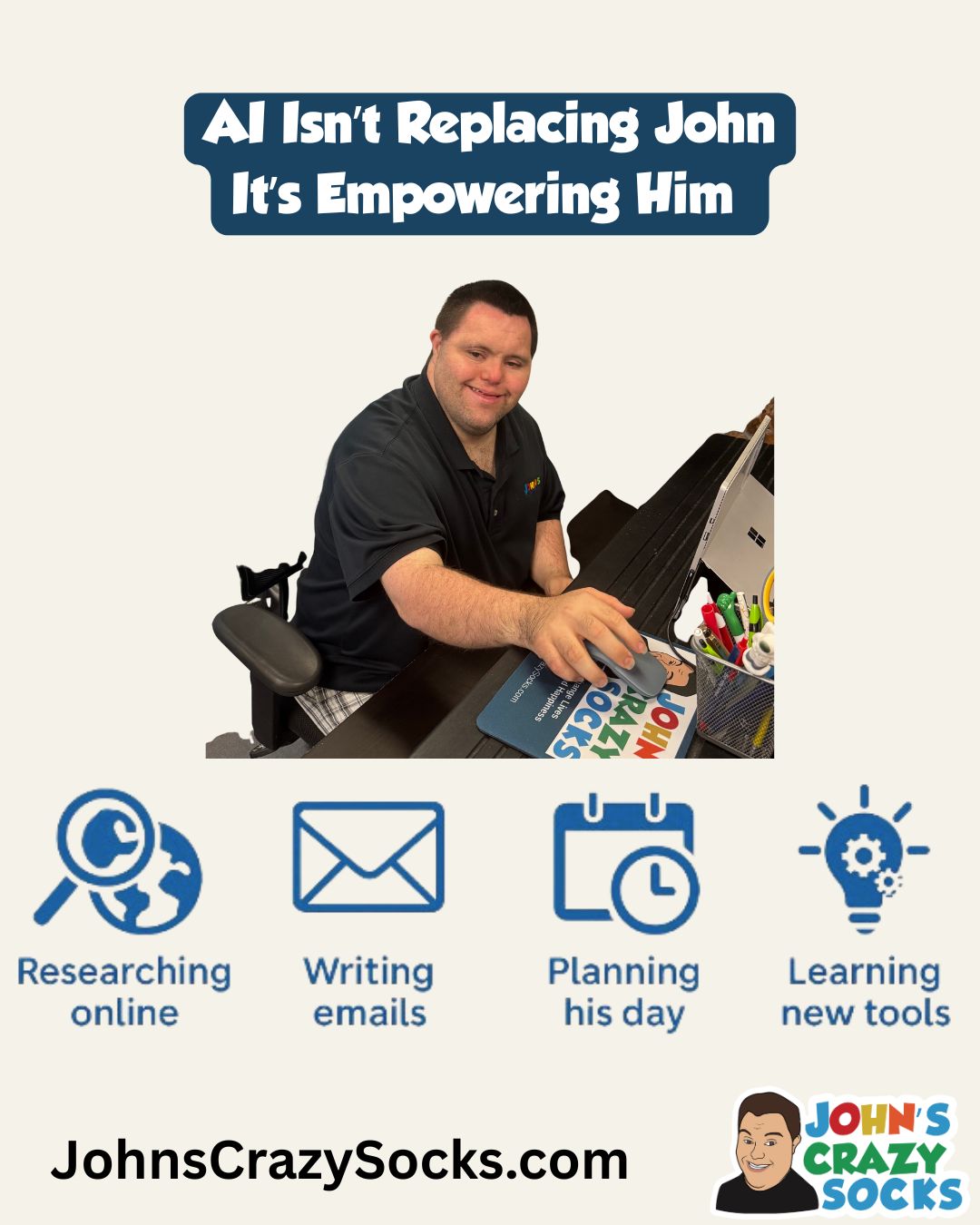
He also loves what he calls “doing research.” That might mean finding a great restaurant in a new city, learning about a historical figure he heard about in a movie, or checking on the weather for an upcoming trip. He used to spend a lot of time Googling, often getting overwhelmed by cluttered results. Now? He uses Perplexity AI. He types in what he wants to know and gets clear, easy-to-understand answers—fast. Even better, he simply talks to Perplexity, which has learned to understand John.
Here’s a recent example. We had a speaking engagement in Boise, Idaho. John used Perplexity to learn about local foods (finger steaks), the best place to get them (Westside Drive-In), and how to get there.
AI Helps John with his Email
John also sends a lot of emails and text messages. He does this as part of his work. He does this to stay in touch with his Special Olympics coaches. And he does it to communicate with friends.
John knows what he wants to say, but he struggles sometimes with grammar and word choice. Now, John uses ChatGPT as his writing assistant. He tells ChatGPT what he wants to say, and the AI helps him write his message. It is still John and his words, but it is now a clearer and more understandable message.
AI Helps John with His Schedule
And like most entrepreneurs, John juggles a packed schedule. I often joke that he is the hardest working man in sockdom. On any given day, John may need to record some videos, attend a meeting (he chairs our Daily Briefing that starts every day), record a podcast interview, meet with a potential business partner, help pick orders and attend a practice in the evening. I told you, he has a lot going on and keeping it all organized would be a challenge for anyone.
John uses ChatGPT as his personal assistant. He tells it (Yes, he likes to talk to the AI) everything he has to do and the Chat produces a schedule for the day.
John is Always Learning and the AI is There to Help Him
John likes to figure things out. Maybe he wants to know how to do something in Microsoft Outlook, or how to find a show to watch on his iPad. When we travel, he likes to plan what to do during a layover. He will turn to the AI for help. He can get step-by-step instructions so he can do the task by himself. The AI supports his mantra: With us, not for us.
These aren’t hypothetical use cases. These are tools John uses every single day—to communicate, to organize, to learn, to grow.
Helping Others Use AI Tools
What has worked for John, we now share with others.
John and I are working directly with self-advocates and families to help them explore how AI tools can support daily life, learning, and communication. Some want help drafting job applications. Others are looking to build routines, explore new topics, or manage emails more confidently. AI can make that possible and we show them how.
We’re also advising businesses that employ people with differing abilities on how to integrate AI into their training and workplace culture. These tools can help employees with IDD:
- Understand instructions more clearly
- Communicate more effectively with colleagues and customers
- Navigate new technology step-by-step
- Build confidence in decision-making and problem-solving
Our goal is simple: to make AI accessible and useful for everyone, including those who have been left out of the tech conversation for too long.
Let’s Stop Assuming and Start Exploring
Too often, people assume that individuals with intellectual or developmental disabilities can’t use the latest technology. That assumption is not only false, it’s damaging.
John is proof that, with the right support, AI can empower people with IDD to live fuller lives and contribute more in the workplace. He’s using AI to do real work, solve real problems, and pursue his passions.
And now, he’s helping others do the same.
As John says, “I have Down syndrome, but Down syndrome never holds me back.” It doesn’t and neither should technology.
So let’s stop fearing what AI might take away and start exploring what it can give us—especially when it comes to inclusion, independence, and opportunity.
Because when we give everyone the right tools, amazing things happen.